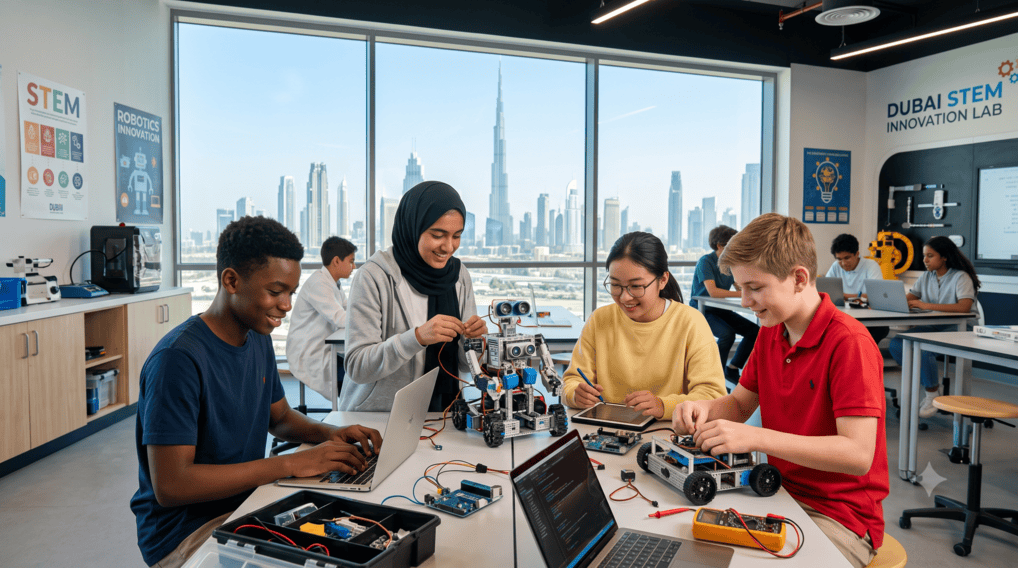


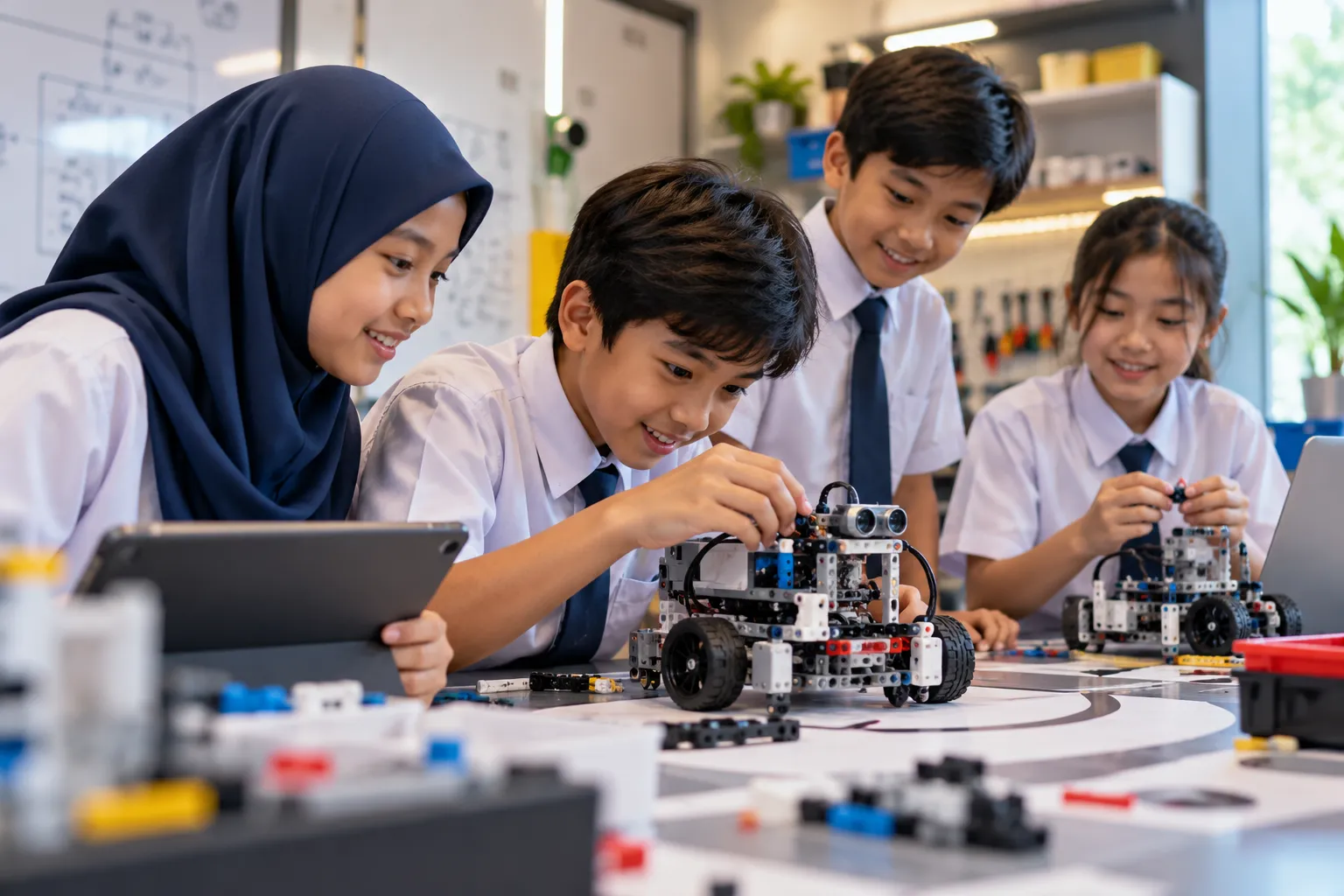
A robot shows the result of every instruction at once. A robot that misses its turn shows the miss on the floor. A 2026 paper in the European Journal of Education examined robotics classrooms. The paper looked at problem-solving skills and cognitive development among higher education students.
Those students were in higher education, so the findings may not carry over to a school classroom. A robotics curriculum for schools can ask the same question of younger students. Which lesson habits build problem-solving?
Why Does a Fault on a Robot Teach More Than a Wrong Answer on Paper?
A robot follows its program exactly. When it misbehaves, the symptom shows as movement, sound or light. A student can name the symptom and start tracing its cause.
That makes every fault a puzzle with an answer, and the answer can be tested. The student sees the result of a fix on the next run, not on the next report card.
What Does the K-12 Meta-Analysis Show?
A 2024 meta-analysis covered 20 K-12 studies published between 2011 and 2021. The analysis put the overall effect of educational robotics at 0.821. Creativity improved more than problem-solving, and both moved in a positive direction. A term can end with an open brief, where students decide what to build.
Does Age or Course Length Change the Result?
The same meta-analysis found the strongest effect in kindergarten children and a smaller effect in middle school students. A separate meta-analysis of eight studies with 567 primary-school children found a medium positive effect on cognitive outcomes. The standardized mean difference was 0.641, significantly higher than for non-robotics learning. The effect was slightly larger for first- to third-graders than for fourth- to sixth-graders.
Length is less settled. The K-12 meta-analysis found positive effects at every course length, and the benefit declined as courses grew longer. The primary-school analysis concluded that interventions should last no more than four weeks and involve robot construction. A 2024 analysis of 21 studies, covered below, found length was not a significant moderator.
The evidence on length is mixed. A school can run four-week cycles and compare results from one cycle to the next. The term plan below shows one way.
What Happens When Students Study Their Own Errors?
A 2025 study with 85 primary students used robotics activities that included an AI algorithm. Students began to think about their own errors and chose more reflective ways to solve problems. Their overall results rose significantly between a maths pre-test and post-test. The rise was particularly clear among low-achieving students and students with special needs. The authors call for larger studies to confirm these early findings.
A role swap lets every student practise diagnosis. In one lesson a student predicts, builds, observes or explains, and the roles rotate. A student who finds building hard can still lead the diagnosis.
What Does One Lesson Look Like?
A robotics curriculum for schools can run the same five steps with any kit:
- Predict: the pair writes what the robot should do and why.
- Build: the pair assembles and programs the first version.
- Test: the class runs the build and records what happens.
- Diagnose: the pair names the symptom, then changes one thing at a time and logs each change.
- Explain: the pair tells another pair what changed, why, and what happened next.
The teacher offers an answer only after a pair has tried twice.
What Does the Routine Look Like With a Real Fault?
Take a pair whose line-following robot leaves the line at every right turn. They predicted a smooth turn and got a drift. They name the symptom: the robot drifts right.
They change one thing, the speed of the right motor, and run the build again. The log records the change and the result. In the explain step, they tell another pair why the speed was the cause.
How Can Teachers See Reasoning, Not Only the Robot?
A working robot shows that a build ended well. The fault log and the spoken explanation show how the pair got there. Two pairs can finish with identical robots after very different routes.
A teacher can read three things in a log. One is whether each test changed a single variable. Another is whether the written cause matches the fix. The last is whether the explanation made sense to the listening pair.
How Many Kits Does a Class Need?
Group size sets how many builds a class needs. A class of 30 working in pairs needs 15 builds. The same class in groups of three needs 10, and a robotics curriculum for schools can choose either.
Planning around that number helps avoid a stall where one build serves a whole row. Students who wait their turn watch instead of diagnose. Spare sensors and wires let a pair keep a faulty build on its desk until the next lesson.
What Can Early Finishers Do?
Some pairs finish the first build while others are still diagnosing. The fault swap gives them a harder job. The pair plants one deliberate fault in their working robot and hands it to a neighbouring pair.
The neighbours run the routine from the start: predict, test, diagnose, explain. The planting pair then checks the diagnosis against the fault they hid. Both pairs practise reading symptoms, and the early finishers also practise explaining a cause they already know. A labelled box for swapped builds helps each pair find its own at the next lesson.
How Should a Teacher Treat a Wrong Prediction?
Students often read a wrong prediction as a mistake. In this routine it is the first piece of evidence. The distance between what the pair expected and what the robot did tells them where to look.
A teacher can say so aloud and praise the pair that records a surprise. That habit keeps a robotics curriculum for schools from rewarding only the fastest working robot.
What Should a Teacher Prepare Before the First Lesson?
Run every build once before students do. Note the faults a first-time builder is likely to meet. Examples are a loose wire, a low battery or a sensor in the wrong port. Keep that short list for yourself, not for the class.
The list helps in two ways. A teacher who knows the likely faults can ask sharper questions than a general check on what went wrong. The teacher can also tell a hardware slip from a reasoning slip. That keeps the lesson focused on reasoning.
How Can Families See the Reasoning?
Ask each student to bring home one sentence from the explain step. A short pause before pack-up is enough to write it down. A parent who hears that sentence learns more than one who sees only a finished robot. A robotics curriculum for schools that sends home a sentence a week gives families a window into the thinking.
How Might a Twelve-Week Term Run?
The four-week finding suggests three cycles in a term. A school can plan each cycle around a different build. Here is one plan for a project-based robotics curriculum for schools:
| Cycle | Weeks | Build | Teacher's Role |
| 1 | 1 to 4 | A first working build from a guided plan | Models the routine step by step |
| 2 | 5 to 8 | A redesign that adds a sensor or a new rule | Coaches with questions |
| 3 | 9 to 12 | A team project with an open brief | Reads the fault logs and gives feedback |
Each cycle stays within four weeks. After cycle three, the class can compare its logs from the first and last cycle.
What Does Cyber Square Add?
In our Project Suite at Cyber Square, the robotics project list includes line-following and obstacle-avoiding robots. A fault in those builds shows up on the floor, where the whole pair can see it.
How Should a School Weigh This Evidence?
Each study measures a defined group in a specific setting. The first paper covers higher education only, the primary-school studies are small, and meta-analyses combine very different programmes. Together they point toward gains in problem-solving and creativity.
A 2024 meta-analysis of 21 studies with 2,433 participants found a moderate-sized effect on STEM learning. Among subject areas, the largest effect appeared in technology. Learning performance showed a moderate-to-large effect overall. Only four of its studies addressed computational thinking.
Lesson design, teacher confidence and class context shape the result in any one school. A robotics curriculum for schools is best judged by how it is taught, as well as by the research.
How Can a School Compare Programmes Fairly?
Compare them on three points. How often do students explain their reasoning? How large are the working groups? What records does the teacher keep?
Read our guide to the best robotics curriculum for schools in 2026. It covers hardware, grade-by-grade progression, teacher support and assessment.
Choose the First Robotics Project for a Class
Teachers can choose a robotics project from Cyber Square’s Project Suite for the first lesson. Each project is mapped to a grade level and a learning outcome. A teacher can match the project to the class.