

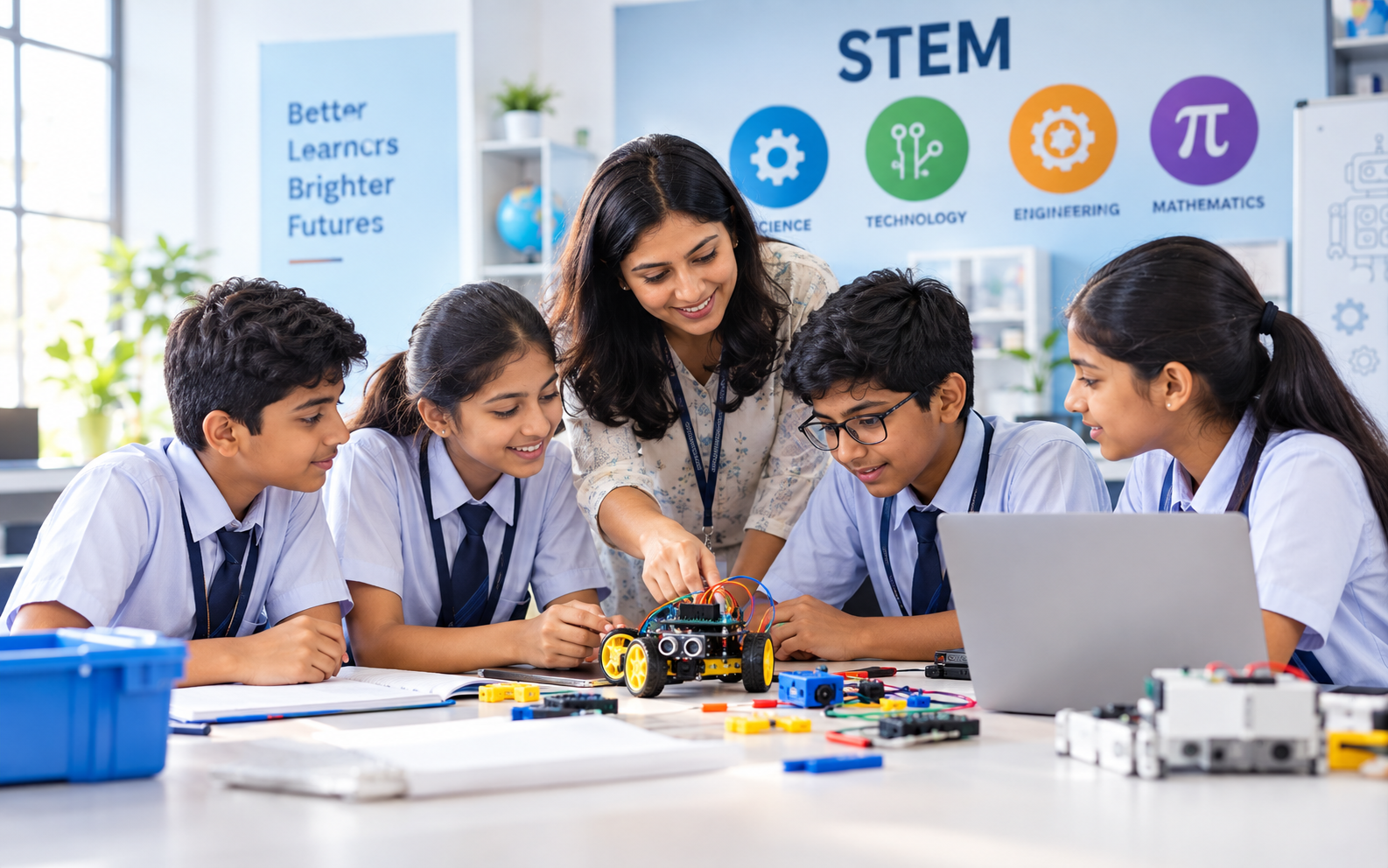
A STEM curriculum provider for schools in India delivers coding, robotics and AI as one connected subject. Not three separate purchases a school has to assemble itself. That distinction decides whether a programme survives past its first year.
India's own STEM push already has real scale behind it. Under NITI Aayog's Atal Innovation Mission, Atal Tinkering Labs now run in over 10,000 schools. That footprint spans 35 states and union territories.
More than 10 million students are already involved. The Union Budget 2026-27 backed a five-year plan to add 50,000 more labs. Rs 3,200 crore is allocated for the coming year alone. That's a funded national commitment, not a passing trend.
What Should Genuine STEM Coverage Include?
Real coverage means all four letters, taught in sequence. Not one subject wearing a bigger label. Look for these elements together:
- Coding that progresses from block-based tools to real languages like Python
- Robotics hardware that changes as students get older, not a single kit for six years
- AI taught as its own track, with hands-on model work, not a single lecture
- Marking and reporting that happen automatically, not left for evenings and weekends
A provider selling only robotics kits is offering a slice of STEM. So is one selling only a coding app. Neither is the whole subject, whatever the marketing says.
Why Does National Curriculum Alignment Matter So Much?
Because a syllabus that ignores CBSE, ICSE or state board structures forces a school to bridge the gap itself. CBSE partnered directly with Microsoft to build the Class 6 to 8 coding curriculum under NEP 2020. It also folded AI into the curriculum at relevant stages.
A provider should map directly onto that structure, grade by grade. Not adapt a generic international pack after the fact. Ask to see the actual mapping document. A provider without one is asking a school to trust a claim it cannot verify.
Does a Private Curriculum Compete With Government Programmes Like ATL?
No, and treating it that way misses the point entirely. Atal Tinkering Labs give students access to hardware and a maker space. They don't typically deliver a structured, marked, grade-by-grade curriculum on their own.
A STEM curriculum provider for schools in India can run alongside a school's existing ATL. That gives the hardware a structured syllabus, not an open lab with no fixed lesson plan.
How Does Cyber Square Actually Deliver This?
Cyber Square runs coding, robotics and AI as one connected system. It's been refined since 2014. That system now reaches over 500 partner schools. Its 500,000 students span India, the UAE, Saudi Arabia and beyond. Every course carries UK certification.
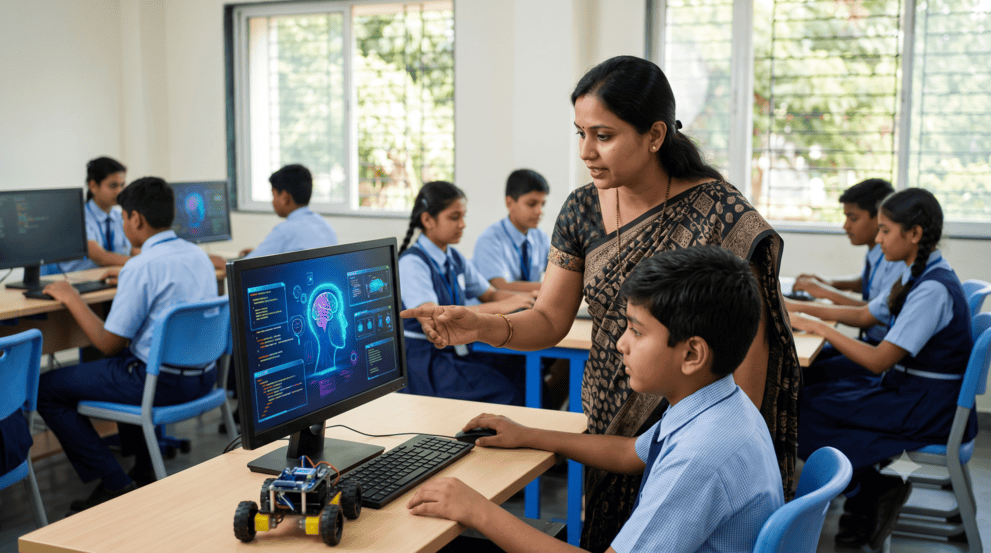
While students build, test, and interact with real-world machine learning models inside our hands-on AI Cloud Lab, assignment tracking and automated evaluation are managed seamlessly through Cyber Square’s Integrated LMS. Giving teachers real-time visibility without adding manual grading hours.
What Sets Us Apart From a Typical Coding App?
We built our platform to be checked, not just trusted on our word. We're listed on the Microsoft Marketplace as a vetted education platform. That's paired with our own AWS Qualified Software Partner status. Two major cloud providers, not one, have reviewed how we handle infrastructure and data.
That double verification matters because most STEM providers offer none. A school checking our credentials finds real, independently maintained listings, not just a page we control ourselves.
Teachers get a guide written for people with no coding background. Most computer teachers in India never trained as software developers. A provider that assumes otherwise sets them up to fail.
What Does Hands-On AI Actually Look Like for a Student?
It looks like training a model and watching it get something wrong. Not reading a textbook definition. A serious AI curriculum provider for schools in India breaks the subject into distinct skill areas:
- Computer vision. Students feed a model labelled images, then test whether it sorts a new one correctly.
- Speech processing. Students record voice clips and check whether a model triggers the right response.
- Machine learning. Students build a small dataset and see how well a trained model predicts from it.
That structure teaches more than any chapter on AI terminology could on its own.
How Should Robotics Hardware Progress by Age?
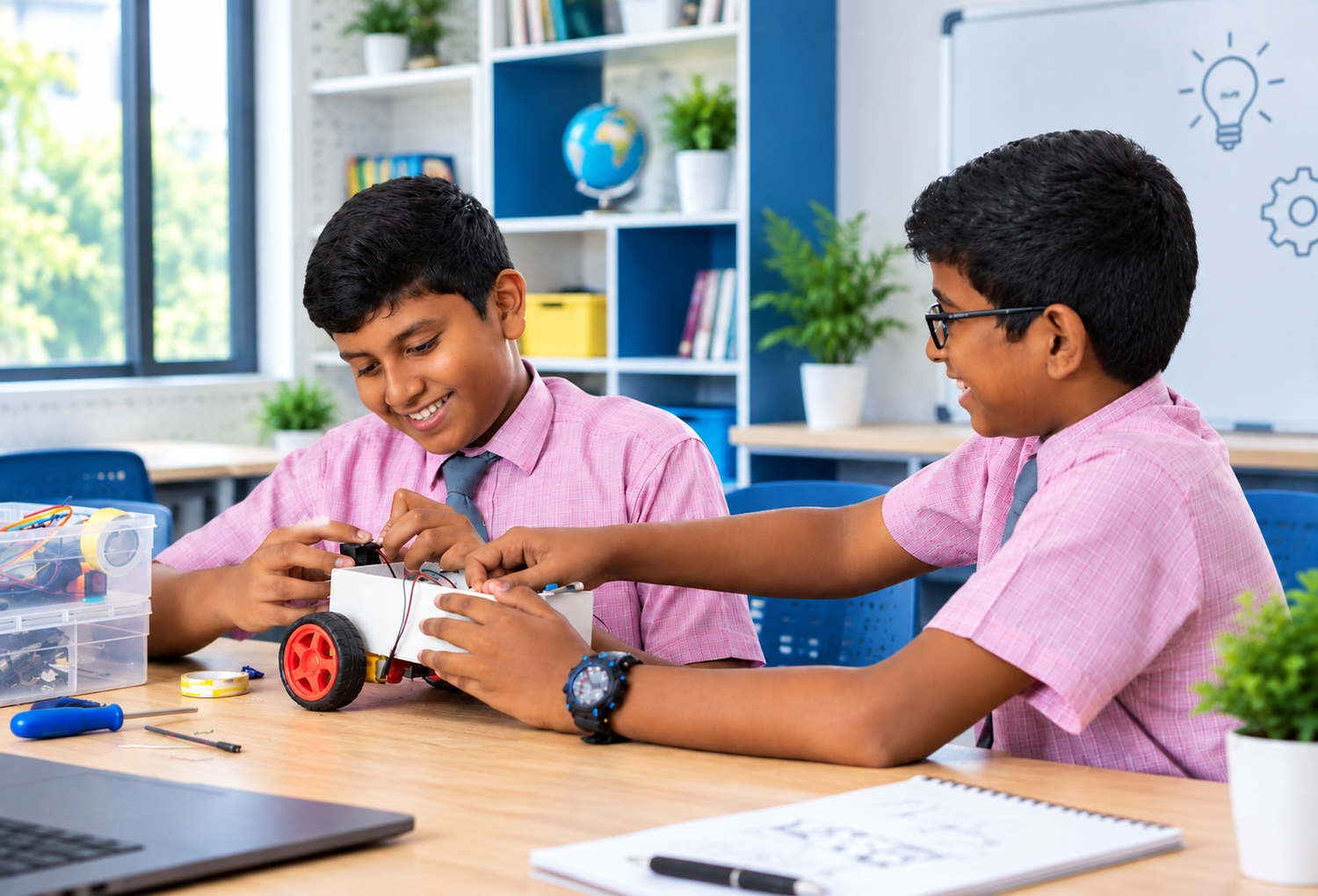
Gradually, and in a specific order. Younger students need boards that are cheap to replace and hard to damage permanently. Pairing that with block-based coding works better than typed syntax at this age. A seven-year-old debugging a missing semicolon learns nothing about logic, only frustration with punctuation.
Older students take on components with real consequences, where a wiring mistake actually matters. That's part of the lesson, not a failure of it. A single kit stretched across six years wastes everyone's time. In practice, the path looks like this:
| Grade Band | Hardware | Coding Approach | Sample Build |
| Grade 2 to 4 | Micro:bit | Block coding | Motion-activated light |
| Grade 5 to 8 | Arduino, basic sensors | Block coding into simple Python | Automatic plant waterer |
| Grade 9 and up | Raspberry Pi, actuators | Python, applied AI models | Obstacle-avoiding robot |
Does This Fit Inside an Existing CBSE or ICSE Timetable?
Yes, without displacing an existing subject. Most Indian schools already run a computer science or activity period this slots naturally into. An addition that forces a school to cut an existing subject rarely survives its first budget review. One that fits inside a period the school already runs tends to stick around.
What Should Parents Be Told?
Enough to understand what their child is building, not a technical manual. Short, plain-language updates work better than a jargon-heavy newsletter nobody reads past the first line.
A few things worth sharing directly:
- What specific project a student is working on this term
- Which skill, not just which tool, that project is building
- Where finished work will be shown, if anywhere beyond the classroom
- How marking works, so a grade doesn't arrive as a surprise
Schools that keep parents informed tend to get fewer questions and more support at renewal time.
Does a Teacher Need a Computer Science Degree to Run This?
No, and providers that assume otherwise set schools up to fail before term even starts. A properly built programme includes training before the first lesson. It also includes a written guide for non-specialists, not a general overview document.
Cyber Square sends qualified teachers on international training trips, at no cost to the school or the teacher. That kind of investment is rare among providers focused only on selling hardware.
What Does a Real Showcase for Student Work Look Like?
Somewhere beyond the classroom. Cyber Square's annual Digital Fest gives finished projects a stage. Students present in front of judges and peers from other schools. That's a real audience, not just a grade in a gradebook nobody outside the school ever sees.
Students move from writing their first line of code to presenting a finished build at a genuine tech competition. A programme with nowhere for finished work to go tends to lose momentum by the second term. That's true regardless of how strong the lessons were.
What Should a School Budget For?
More than kit prices. A realistic budget covers curriculum licensing, teacher training, marking infrastructure and ongoing support. A few direct questions cut through vague quotes fast:
- Does the price include teacher training, or is that billed separately later?
- Is marking part of the base package, or an added cost per student?
- What happens to the price if the school adds a second grade band next year?
- Is there a minimum contract length, or can a school pilot one grade first?
Cyber Square's Credentials At a Glance
A school shouldn't need a sales call to find these answers:
| Credential | Detail |
| Track record | Curriculum running since 2014 |
| School reach | 500+ schools, 500,000+ students |
| Certification | UK-certified courses |
| Cloud partner | AWS Qualified Software Partner |
| Marking | Same-day, AI-evaluated |
| Curriculum span | K-12 |
Built-In-House vs a Structured Programme
| Factor | Building It Alone | Cyber Square |
| Subject coverage | Coding, robotics, AI sourced separately | One connected system |
| Teacher readiness | Assumes prior coding knowledge | Built for zero technical background |
| Marking | Manual, queued behind other work | Automatic, same day |
| National alignment | Adapted after the fact | Mapped to CBSE and NEP 2020 |
| Showcase for finished work | None | Digital Fest, international audience |
A Short Checklist Before Signing Anything
- Ask for the exact CBSE or state board mapping document, not a general claim
- Confirm marking is automatic, not something a teacher does after hours
- Ask specifically how AI is taught, not just whether it appears on a slide
- Confirm training happens before term starts, not squeezed in mid-year
- Ask where finished student projects actually go once the term ends
Why This Choice Deserves More Scrutiny Than It Usually Gets
Because a school signs one contract and lives with it for years, not one term. That single decision quietly hands over who trains your teachers and who marks your students. It also decides what "STEM" actually means inside your own classrooms. Most schools spend more time comparing catering options than they do on this.
That's not a decision to make from a features page alone. A STEM curriculum provider for schools in India worth choosing runs the whole system on one idea. It never asks a teacher to assemble a programme from spare parts.
Ready to Start?
Choosing a STEM curriculum provider for schools in India shouldn't come down to trusting a sales pitch. Sign up with Cyber Square and request a live demo of the AI Cloud Lab to see it firsthand.