

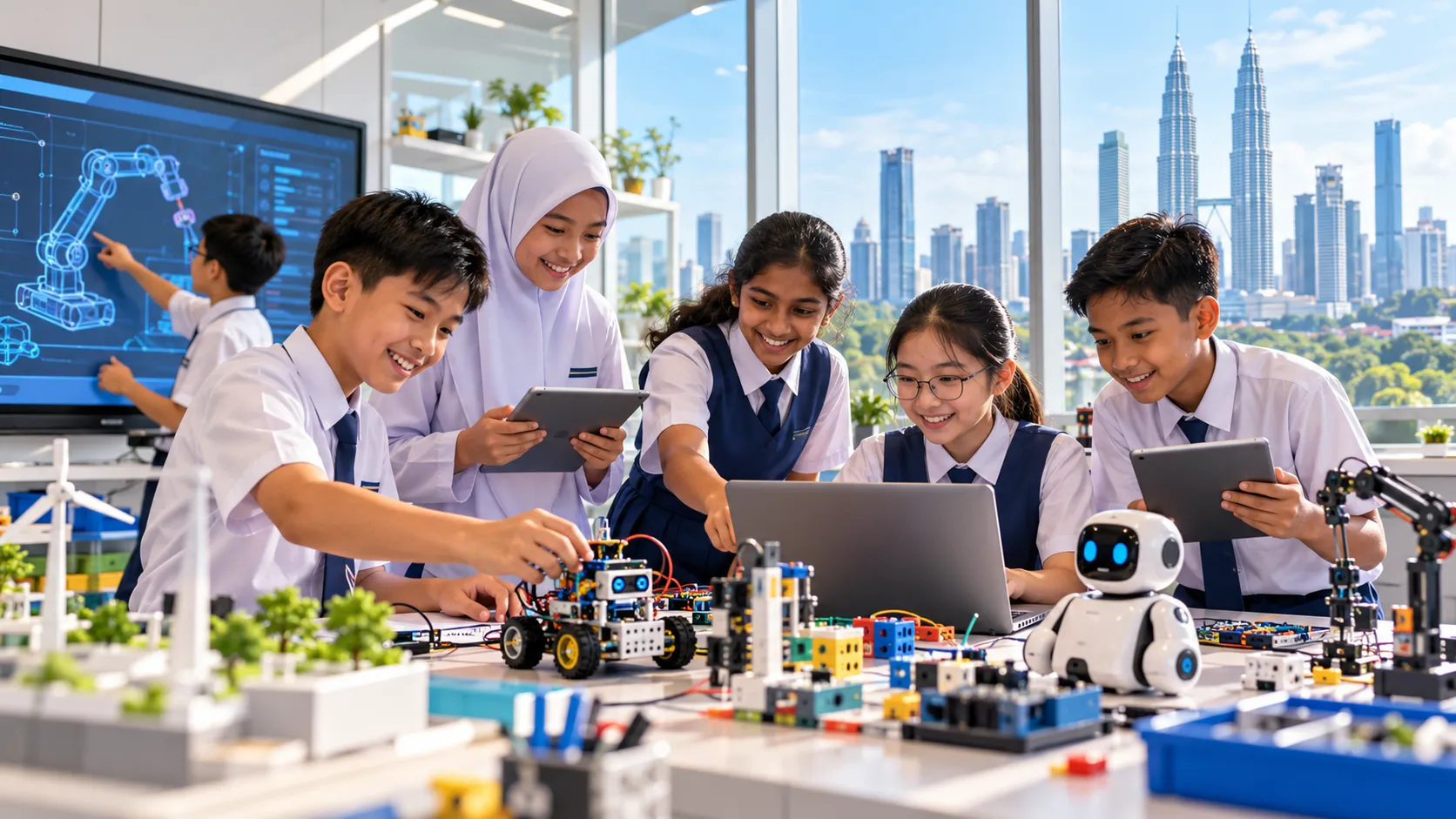
Malaysian classrooms are about to gain a new subject. Primary pupils in Malaysia will meet AI basics from 2027, in a new subject called Technology and Digital. An AI learning platform for schools in Malaysia can give teachers and students practical support as that subject arrives.
The Malaysia Education Blueprint 2026-2035 is designed to keep education in step with developments in AI.
The Education Minister has also stressed pupils who use computational thinking for problem-solving and creativity.
What Does the Ministry's Plan Mean for STEM Teaching?
In secondary schools, students study AI principles in computer science, ICT, and design and technology. Technology and Digital is one of six new subjects in the revamped 2027 curriculum. The ministry says the subjects combine science, arts, music, health, technical and vocational education, and digital skills. Its curriculum development director said students learn by doing and by making connections across disciplines.
Hands-on learning needs a place to happen. An AI learning platform for schools in Malaysia gives those activities a shared home.
Which Six Subjects Arrive in 2027?
The ministry's six new subjects reach different year groups:
| Subject | Where It Begins |
| Alam dan Manusia | Years 1 and 2 |
| Eksplorasi Sains dan Teknologi | Years 3 and 4 |
| Eksplorasi Seni dan Dunia | Years 3 and 4 |
| Technology and Digital | Across primary school |
| Bahasa Isyarat Malaysia | Year 1, at selected schools with integrated special-education programmes |
| Bahasa Arab Komunikasi | Form 1, at daily and residential schools |
The ministry says the subjects strengthen basic skills and character development early in schooling.
Eksplorasi Sains dan Teknologi and Technology and Digital sit closest to STEM teaching. Schools can plan AI work around the years in which those two subjects begin.
What Is Fasih Digital?
The ministry plans to add a new skill called Fasih Digital, meaning digital proficiency. It joins the seven existing basic competencies. Training and testing a model gives students one way to practise digital proficiency.
How Does Malaysia's New Assessment Framework Connect?
Preschool to Year 2 pupils are assessed at three performance levels: Know, Understand and Do. From Year 3 to Form 5, a fourth level, Apply, is added. UPSR and PT3 are not returning. The SPM continues, and school-based assessment is strengthened. The ministry says teachers can track progress more effectively this way.
Which AI Projects Do Students Build?
Students work through one of three real AI project types: object detection, face detection or speech recognition. Each is trained and tested against real data rather than described in theory. Cyber Square's AI learning platform for schools in Malaysia offers all three. Each one teaches a different lesson about how models behave.
How Does Object Detection Build Honest Habits?
A student trains a model to spot a specific object in a photo. Then the student tests it against new images the model has never seen. The gap between working on training data and working on anything new is where the real learning happens.
A high score on training data does not guarantee a model works. Students learn that distinction early, in a concrete way.
At Cyber Square, we treat a wrong model as the lesson. The student traces the mistake to its source and tries again. A student might train a model on photos of pencils and rulers. Then the student tests it on a photo taken in a darker corner.
What Do Face Detection and Speech Recognition Add?
Face detection raises harder questions than object detection does. What counts as a face at an angle, in poor lighting or partly covered? Working through those cases teaches edge cases directly. The model either handles the case in front of the student or visibly does not.
Speech recognition adds a different idea. A model that mishears an accent or background noise shows what part of the audio carries meaning. Students see signal and noise in a way a textbook description rarely captures. Failures here are specific and audible in the moment.
A pair can record one word in a quiet room, then again in a busy corridor. They compare the two results side by side.
What Happens After Students Master the Three Projects?
Once students can train and test models without step-by-step guidance, they get room to extend those skills. The Project Suite lets them combine or stretch what they know into something nobody assigned. AI becomes a subject to build with, not just one to recall facts about on a written test.
Most students meet AI as a recommendation, a filter or a chatbot answer. Here a student stands on the other side of the decision. The student chooses the training data and lives with the result of those choices.
How Does a Teacher See Progress Across a Term?
At Cyber Square, we log every model a student trains and every accuracy result automatically. A teacher can see improvement across the term, rather than judging a hands-on subject by one end-of-term score. The platform also reports performance analytics and personalised learning insights.
Educators monitor progress through an intuitive dashboard. With this view, an AI learning platform for schools in Malaysia lets teachers focus on the hardest concepts.
What Can Students See for Themselves?
Cyber Square gives every registered student a separate login. There, students view their course progress, assignments from teachers, batch performance and progress cards. Evaluated submissions bring instant feedback, so a student knows the next step quickly.
Assignments include matching, fill-in-the-blank, true or false questions and coding challenges. That variety suits a subject that mixes concepts with hands-on tasks.
How Do Teachers With No AI Background Get Started?
Training sessions run off site before the first AI lesson.
The very first lesson has students train a model, often by telling two objects apart. Learning starts with real AI work, not a lesson of definitions. No prior coding experience is needed to begin.
How Does Cyber Square Reach Students Beyond the Classroom?
Our mobile app, designed for students from Grade 1 to 12, extends learning beyond school hours. Teachers can monitor Cloud Lab activity from the same app.
The Education Ministry also aims to equip 10,000 schools with smartboards by 2027 to prepare for the new curriculum. A browser-based AI learning platform for schools in Malaysia fits shared classroom screens such as smartboards. A teacher can show one trained model to the whole class on a single screen.
How Do Parents and Competitions Fit In?
At Cyber Square, we host plain-language orientation sessions for parents. They explain what students are building and why it matters. Parents then see the real-world value of their children's digital progress.
We also give administrative and technical entry support for Malaysia's National AI Competition.
What Do Pilot Schools and Experts Say?
The Education Minister has said that selected pilot schools use AI-powered platforms. They identify early risks of dropout and offer customised remediation. Pathmanathan Muniandy of the Association of Internet-of-Things Malaysia adds a note of care. He warns that AI introduced without proper guidance may lead to wastage and over-reliance. He suggests integrating AI into existing subjects such as Maths and Science.
What Should Schools Prepare For?
Malaysia's AI journey includes three areas to strengthen: the digital divide, teacher competency and STEM engagement among young people.
Equal access and confident teachers make any AI learning platform for schools in Malaysia work better. A school can list its access gaps and training needs before term one begins. It can review the list each term.
How Might a School Pilot One Grade Band?
Choose one grade band for an AI learning platform for schools in Malaysia, such as Years 5 and 6. Train its teachers before the first AI lesson.
Decide in advance what a good term looks like. For example, every student has at least one trained model. In term one, run the object detection project. Review each student's training log when the term ends.
In term two, add face detection and speech recognition. By then the teachers know the routine, and the first term's logs show where students need help. At the end of term two, compare the logs from both terms. Ask teachers which project needed the most help, and plan the next year around the answer.
What Does Our Computer Science Strand Cover Beyond AI?
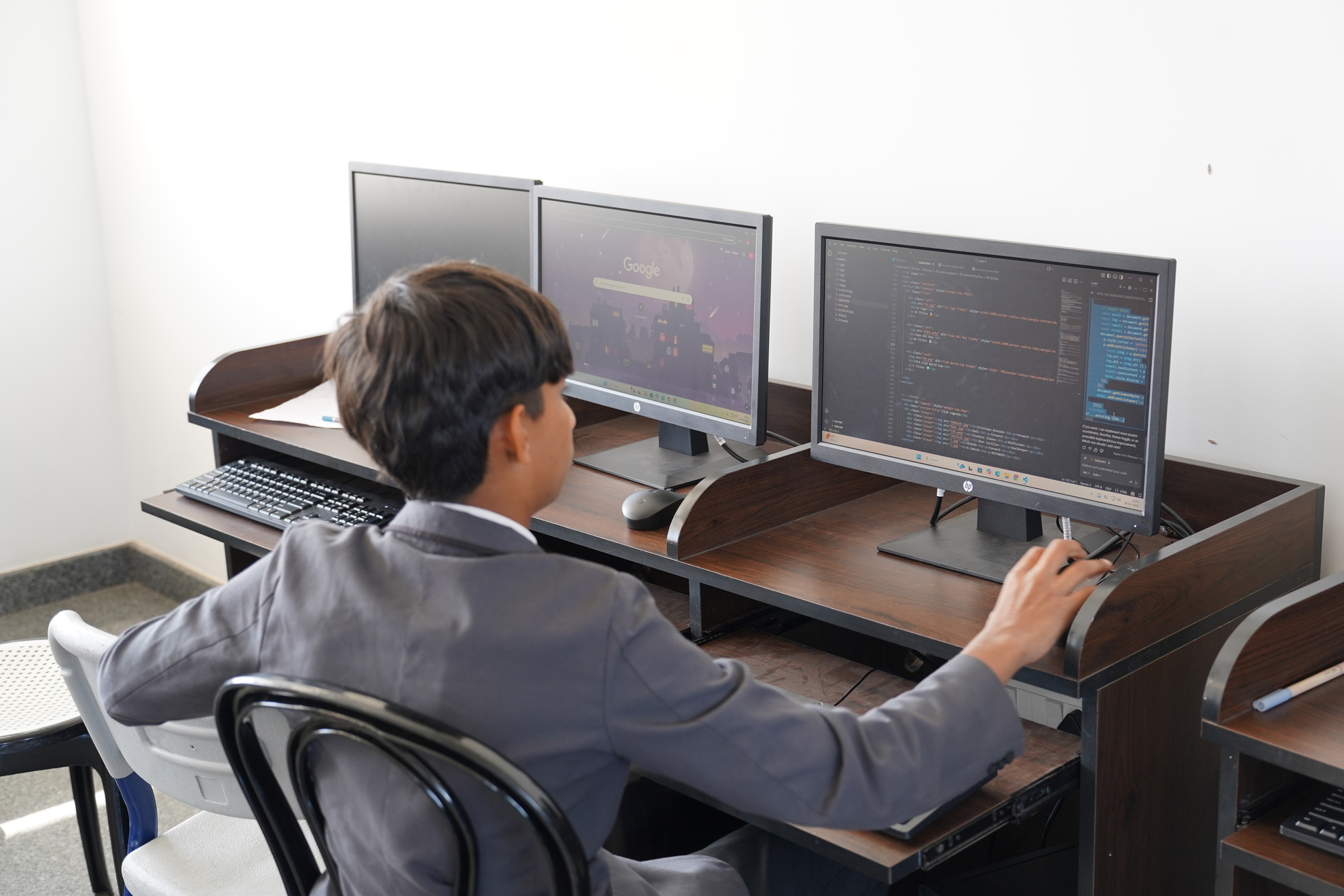
Our computer science program for Malaysian schools has four parts. Data, Algorithms and Python covers variables, data types, loops, conditionals, functions, lists and dictionaries. Web development uses HTML, CSS and JavaScript, with SQL for database work. A built-in typing tool runs short, timed drills. The CS Project Suite gives each student a place to plan, test and adjust a full project.
Cyber Square's AI learning platform for schools in Malaysia also supports this strand. The program works alongside KSSM, British, IB and American curricula. Students can meet the same skills, whichever syllabus their school follows.
Train Your Students' First Model on Cyber Square
Explore Cyber Square's platform for schools in Malaysia. Your students can train and test object detection, face detection and speech recognition models there.