

Schools partner with a coding curriculum provider in India because running a coding programme alone involves solving four separate problems at once: lesson content, teacher training, marking, and hardware. Most schools solve one or two of these well and quietly fail at the rest.
According to the U.S. International Trade Administration's market intelligence report on India's K-12 sector, India's education system serves over 250 million students. In the Union Budget presented on February 1, 2026, India's Ministry of Education received ₹1.39 lakh crore, an 8.27% increase over the previous year and the highest allocation to date.
Coding, AI, and robotics modules are now being written directly into the national curriculum. That policy shift is exactly why schools are no longer trying to build this alone.
What Does a School Actually Give Up by Building a Coding Programme In-House?
A school that builds its own coding programme usually ends up managing four unrelated suppliers instead of one coherent system. Here's what that split typically looks like against a bundled coding curriculum provider in India:
| Component | Built In-House | With a Coding Curriculum Provider in India |
|---|---|---|
| Lesson content | Sourced from a separate publisher, often generic | Grade-mapped, updated with current curriculum standards |
| Teacher training | An optional add-on, if budgeted at all | Included as standard, delivered off-site |
| Marking | Falls on the teacher, submission by submission | Automated, dashboard-driven |
| Hardware | Ordered separately, rarely matched to the syllabus | Bundled and matched to grade level |
| Showcase opportunity | Usually none beyond the classroom | Built in through national-level events |
Why Does the Curriculum Need to Change Grade by Grade?
A curriculum that repeats the same content across grades is the single biggest reason coding programmes lose effectiveness after year one. As an AI curriculum provider for schools in India, Cyber Square built its curriculum specifically to avoid that, updating grade by grade instead of repeating content.
| Stage | Grades | What Students Actually Build |
|---|---|---|
| Foundational | KG to Grade 2 | ICT basics, digital literacy, mouse and keyboard skills, block sequencing |
| Early coding | Grades 3 to 5 | Scratch, introductory logic, first robotics builds |
| Applied coding | Grades 6 to 8 | Python, HTML, CSS3, JavaScript, introductory AI concepts |
| Board-facing | Grades 9 to 12 | CBSE-named subjects such as AI Code 417, plus full-stack robotics |
What Do Students Actually Build With Their Hands?
Coding on a screen teaches syntax. It rarely teaches a student that code can control something physical, and that gap is a separate skill worth building deliberately.
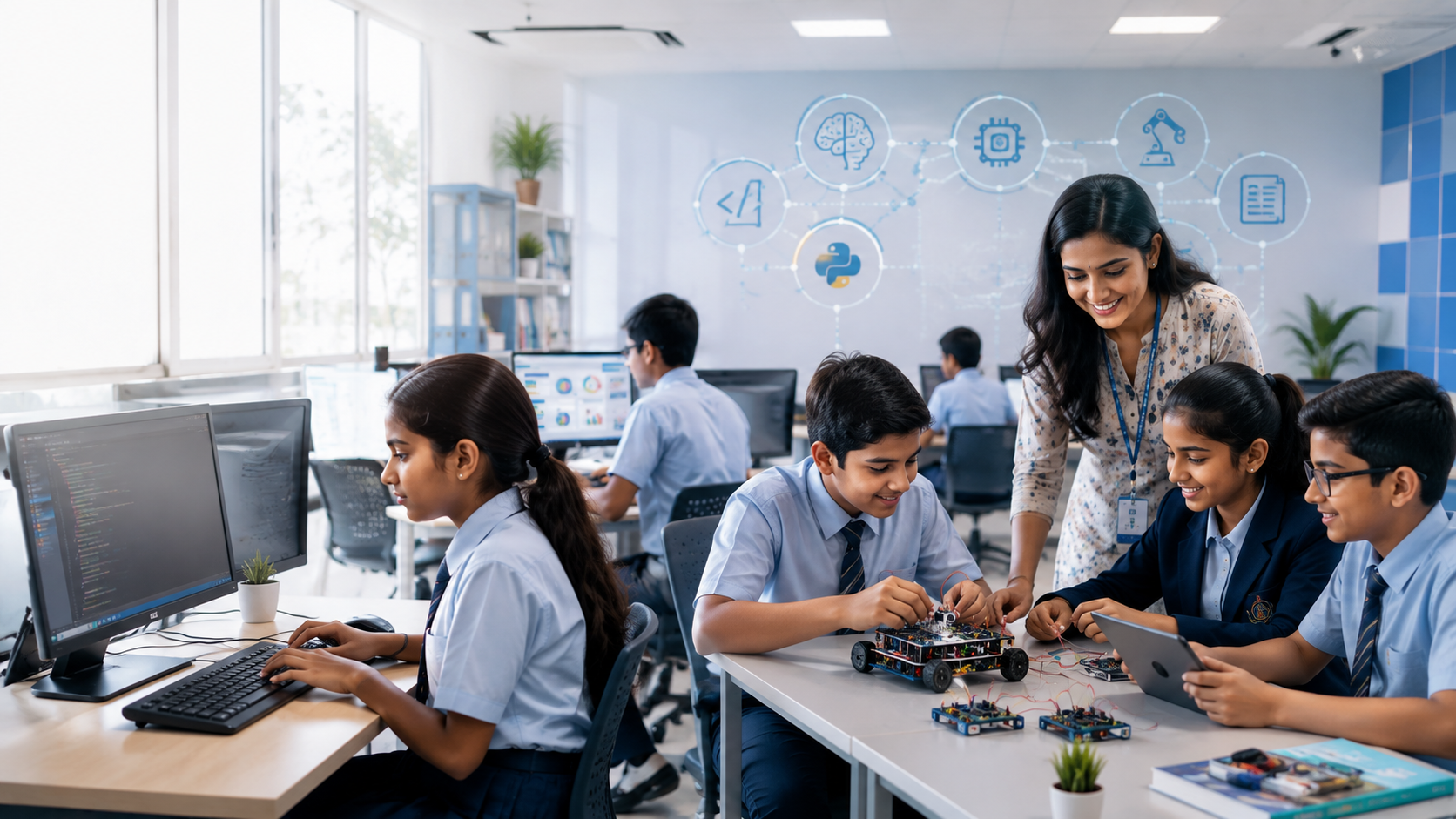
Cyber Square's robotics kits include:
- A blind stick and a pair of smart glasses built for the visually impaired
- A radar unit that detects and measures distance to nearby objects
- A full IoT-based home automation setup, controlled from a student-built dashboard
Each build is coded in Scratch or Python depending on the student's grade. The assistive-tech angle isn't there for show; it's a chance for a student to build something that helps someone else.
Does Marking Actually Get Faster, or Just Move Online?
Marking speed only improves if evaluation happens automatically, not just digitally. A PDF worksheet marked by hand is still marked by hand, no matter what device it's viewed on.
Cyber Square's automated marking system is built into the platform students already use for lessons. It checks every student submission as soon as it lands. A teacher opens a single dashboard to see exactly where every student in every class stands, without grading each submission by hand first.
Does This Actually Line Up With What CBSE Is Doing Right Now?
Yes, and this is where a generic curriculum tends to fall behind. As an AI curriculum provider for schools in India, Cyber Square's curriculum is updated directly against national policy changes as they happen, rather than waiting on a slower adaptation cycle.
| Policy Signal | What It Requires | How the Curriculum Responds |
|---|---|---|
| NEP 2020 | Skill-based, experiential learning from an early age | Project-based builds from Grade 3 onward |
| National Curriculum Framework | Structured progression across stages | Four-stage curriculum, KG through Grade 12 |
| CBSE board codes | Named subjects like AI Code 417 at senior grades, listed in the stage table above | Curriculum builds directly toward these codes |
What Should a Principal Actually Check Before Signing?
Before choosing any coding curriculum provider in India, verify these directly rather than trusting a sales deck:
- Is the curriculum mapped grade by grade, or is last year's content repackaged with a new cover?
- Is teacher training included, or a separate line item added later?
- Is marking automated, or does it still land on a teacher's desk at 9pm?
- Has the curriculum actually kept pace with CBSE's recent changes around AI and computational thinking, or is it still running an older cycle?
- Is there a way for students to show their work outside their own classroom?
If more than one answer is unclear, that's the provider to keep questioning.
Which Type of Provider Is a School Really Choosing Between?
A school isn't just choosing whether to buy a coding curriculum. It's choosing what kind of provider to buy it from, and the three options behave very differently once the contract is signed.
| Provider Type | Built for India's Policy Landscape? | What Happens When CBSE Updates the Syllabus |
|---|---|---|
| International platform imported into India | No, adapted after the fact | School waits for a translation of an update built elsewhere |
| Generic Indian ed-tech reseller | Partially, often assembled from third-party content | Update speed depends on whoever supplied the original content |
| Cyber Square | Yes, kept current with Indian policy as it evolves | Curriculum updates directly, without waiting on a third party |
This is the choice that actually matters once the initial rollout of a new coding programme is over. That's when the first policy change lands, and a school finds out how fast its provider can actually respond.
Why Did We Build Ours This Way?
Because piecing curriculum, training, marking, and hardware together from separate sources doesn't solve a school's problem; it just relocates the work onto the school. We built one system instead, so a school doesn't have to become its own systems integrator.
Cyber Square was founded in 2014 by NP Haris, who also authored AI Conversations Before the Singularity. That founding predates the current AI-in-schools wave by over a decade, and it also predates NEP 2020 itself. Rather than being retrofitted, the curriculum has been kept updated against India's education policy as it's evolved, including the NEP 2020 reforms and CBSE's newer Computational Thinking and AI requirements.
Cyber Square's textbooks are used by 500-plus institutions across India, UAE, Bahrain, and Saudi Arabia. Each grade's content builds directly on the previous one, instead of repeating material a student already covered. Cyber Square also runs academic partnerships with universities and institutions, so a strong student has a specific next step lined up once school ends, not just a certificate.
Work With Us
If your school is still assembling a coding programme from separate pieces, that's the first cost worth cutting. Talk to Cyber Square about what a coding curriculum provider in India looks like when it's actually built as one thing.